
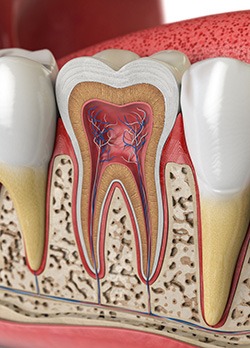
Our teeth have three layers: a layer of protective enamel on the outside, a secondary layer of sensitive dentin underneath, and an inner layer (the pulp) that contains the tooth’s nerve. Under certain circumstances—like a serious injury or deep cavity—an infection develops in this inner chamber. When this happens, the tooth’s health is threatened. Thankfully, we can save it with a root canal. If you are interested in learning more about this emergency dental treatment, including what happens during the procedure, read on or give us a call!

Some of the most common signs of an infected or abscessed tooth include:
If you’ve experienced any of the above, don’t hesitate to contact our dedicated dentist, Dr. Schaffeld, to schedule an appointment.
During your initial visit, Dr. Schaffeld will assess your needs and recommend a treatment plan. If you would benefit from having a root canal, he’ll discuss the procedure with you and answer any questions you might have. That way, you feel completely confident moving forward.
When you arrive at our office for the procedure, Dr. Schaffeld will numb your mouth thoroughly to ensure you don’t feel any pain or discomfort during your time in the treatment chair. Then, he will use special instruments to access the inner chamber of the tooth and remove all traces of infection along with the nerve itself. Next, he will fill your tooth with a safe, biocompatible material known as gutta-percha before placing a protective crown over the treated tooth. This crown does two things: it protects the tooth from developing a new infection, and it restores your tooth’s health, strength, and beauty.

Patients often are less than enthused when they are told they need a root canal. The truth is that there are several benefits that come with this treatment, including:
Do you have any lingering questions about root canals? Are you ready to schedule an appointment? If so, don’t hesitate to take the next step: schedule an appointment!

Even if you know that a root canal is the best way to restore your comfort and oral health, it’s still perfectly reasonable to want to know how much the procedure will cost before you commit to it. While we cannot provide you with a proper cost estimate until we’ve seen you at our office in Enterprise, here’s a brief guide to how we price root canal treatments. If you’d like to know more, please feel free to schedule an appointment.

Several principal factors will determine most of the cost of your root canal. These include:

While it might seem tempting to forgo your root canal and simply have the troubled tooth removed instead, this may be the more expensive option since it will probably lead to more oral health issues later. Tooth loss can lead to a host of problems like uneven enamel wear, dental drift, gum injuries, and difficulty speaking and eating, so we recommend replacing a lost tooth as soon as possible. Treating these oral health issues and placing a restoration can be quite expensive, and it’s always best to save a tooth from being lost when possible. Receiving a root canal can save you much money in the long run, and waiting to receive the treatment may lead to the tooth needing extraction anyway.

Dental insurance plans usually consider root canal treatment to be a major restorative procedure, so it is usually covered by 50% to 80% after the deductible has been met. However, it’s important to confirm what your plan will cover since every policy is different. We’ll be happy to help you navigate your insurance plan so you can understand what it will pay for during your consultation.

We understand that some patients may have trouble fitting their root canal treatments into their budgets, and we’re eager to make sure everyone can get the oral care they need to stay healthy. If you’d like to learn about the financing options we offer, please contact our office in Enterprise.
There are a lot of misconceptions about root canals, including that they are only necessary if a patient is struggling with an excruciating toothache. In reality, there are several other warning signs of considerable decay or damage, including dark discoloration and a pimple-like bump on the gums. If Dr. Tyler Schaffeld notices these or anything else unusual during your exam, he will bring it to your attention, discuss your treatment options, and share his recommendations.
It’s important that you wait until the numbing agent has completely worn off, which typically takes an hour or two. Not only does this ensure that you don’t accidentally burn your mouth, but it also prevents you from biting down on your tongue or sustaining another painful soft tissue injury by mistake.
Another common misconception about root canals is that they are painful. That’s not the case because the first step of the procedure is always the same: to numb the patient’s mouth thoroughly. Not only that, but we provide detailed aftercare instructions to ensure the healing period goes smoothly as well, including rinsing with warm saltwater periodically and taking OTC pain medication as directed.
There isn’t any scientific evidence that links root canals to illness. Despite this, the myth continues to persist. This is largely due to research conducted back in the 1920s by a dentist named Dr. Weston Price. Although he claimed that it was better to extract a tooth, his research was poorly designed. Plus, his original findings have been disproven on several occasions. The sad part is that the opposite is true: your oral and overall health are at risk if you don’t get the restorative care that you need.
Root canals are largely preventable, yes. If you want to keep your teeth and gums healthy, it’s important that you consistently brush, floss, and rinse with mouthwash at home. You should also incorporate other healthy habits into your routine, including wearing a nightguard if you grind your teeth, scheduling a dental checkup every six months, and limiting your intake of sugary foods and drinks.
For one reason or another, patients are often tempted to take the “wait and see” approach. However, doing so can lead to several issues, including the nerve of the tooth dying and the infection spreading throughout your body. That’s why it’s so important to get a root canal in Enterprise when we first recommend it!
Although antibiotics can be used to eliminate infections in other areas of your body, they cannot eliminate tooth infections. The reason for this is simple: the bloodstream cannot reach the pulp, which is where the problem lies. So, in order to restore your healthy, pain-free smile, Dr. Schaffeld needs to either perform a root canal or extract the tooth completely.